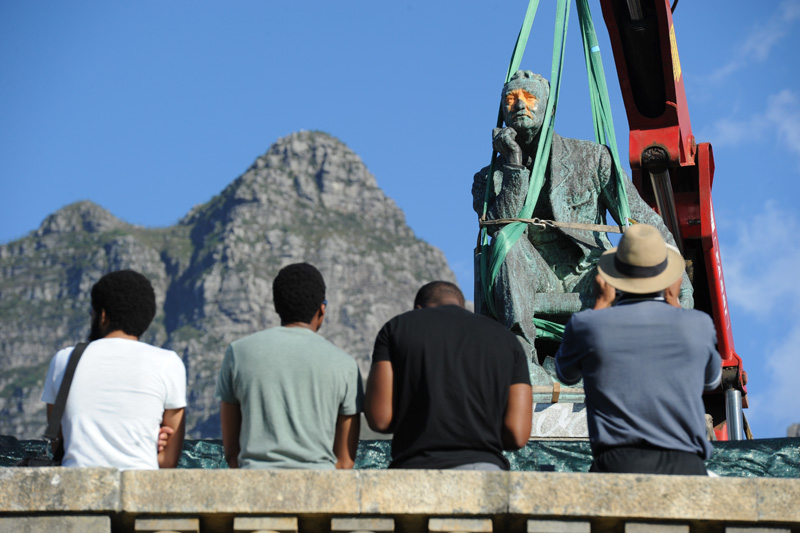
Dr Mapheyeledi Sibindlana emerges as a pivotal figure through her recent PhD accomplishment at the University of Cape Town (UCT). Her study, titled Understanding violence within protest: a case study investigation of the Rhodes Must Fall (RMF) Movement at the University of Cape Town (2015–2016), not only earned her accolades from UCT’s Faculty of Health Sciences in 2024, but also boldly interrogates the intricate layers of violence within the framework of student activism.
Dr Sibindlana’s research critically reframes the understanding of protest violence, positing that conventional interpretations often serve to obscure the deeper power structures inherent within the university system. The RMF movement, renowned for its calls to dismantle the statue of Cecil John Rhodes—a symbol of colonial legacy—marks a significant chapter in South African history. The statue’s removal on 9 April 2015 is a landmark event that continues to resonate in conversations around institutional equity and representation.
Employing decolonial theory, Dr Sibindlana questions the heavy labelling of protests as violent, suggesting that such characterisations are often made without acknowledging the socio-political contexts fostering this contention.
“These interpretations can serve to delegitimise protest and protect institutional authority,” she argues.
Reflecting on her journey, Dr Sibindlana notes, “Getting participants to engage with me was the hardest part,” revealing the dual resistance she faced: there were those sceptical of her right to study violence from a health sciences perspective, alongside discomfort towards her uncompromising decolonial framework. This disquiet often manifested as microaggressions and avoidance, which she identifies as their own forms of violence within academic circles.
“Silence and denial can operate as tools of coloniality,” she contends, prompting a critical re-evaluation of how institutions respond to dissent.
Contrastingly, many participants from the RMF movement—student activists, staff, and workers—embraced her call for dialogue. They recognised the essential need to reflect on protest violence, firmly rooted in South Africa’s protracted struggle against systemic inequality. She challenges the prevailing sentiment that UCT has “moved on” from RMF, asserting that “coloniality endures.” Dr Sibindlana elaborates, “We do the research, cite the theorists, walk across the graduation stage in red gowns, but the structures remain,” a realisation she believes has formidable implications for those affected by the movement.
Dr Sibindlana’s study is notable not just for its focus on student experiences; it also delves into the perspectives of police officers involved in protests. She uncovers the internal conflict many black officers face, torn between their lived experiences and their roles in enforcing a law system steeped in colonial history. “Police often experience dissonance,” she observes, acknowledging the complexities that define their participatory roles in these events.
When asked who would benefit from her research, Dr Sibindlana emphatically states: “It’s for everyone.” Yet, she highlights that higher education institutions must critically reflect on how their roles perpetuate inequality and inhibit true change. “Coloniality continues to endure because it presents itself as normal. RMF really disrupted that—it made the invisible visible.”
